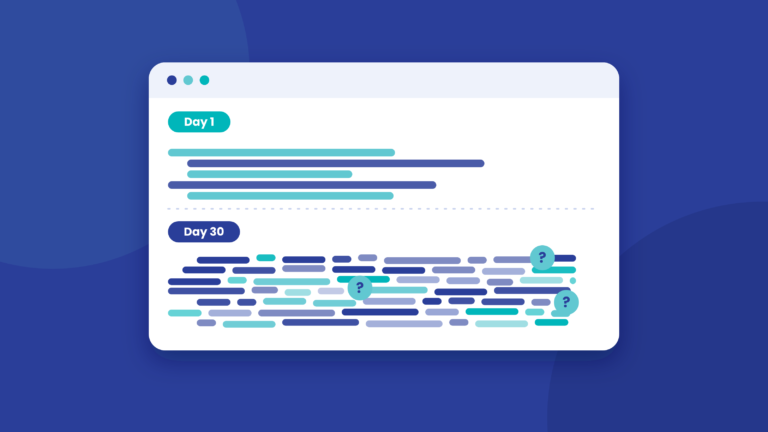
Vibe coding is a great way to get something working fast. You describe what you want, the AI writes it, and by the afternoon you have something that runs.
For the right job, that’s exactly what you want. The trick is knowing which jobs those are.
Where vibe coding works well
Vibe coding is at its best when the job is small, the stakes are low, and you can throw the result away.
What these have in common: few users, little risk, and nobody will miss it if it breaks. For jobs like these, the speed is a real advantage.
Where it starts to hurt
The problems start when a throwaway becomes something your business depends on. Here’s what that looks like.
Nobody knows why it works. Code that was generated and accepted without being read has no owner. When it breaks, someone reads it for the first time, under pressure.
Every fix adds a layer. Ask an AI to patch a bug, and it often patches around it. After ten patches, you have ten layers, and nobody wants to touch the bottom one.
There’s no safety net. Without tests or guardrails (like automated rules, architectural constraints, and operational boundaries), you change one screen, and something else quietly breaks. You find out from a user.
Important decisions get made by default. Logins, payments, permissions, and where user data lives. These need a real decision, not whatever the AI suggested first.
It’s hard to hand over. A new developer joins and asks how the project is organized. The honest answer is “however the AI did it.”
A prototype and a product are different jobs
A prototype answers one question: is this a good idea? A product answers another: can this run for years and keep changing?
Vibe coding is very good at the first job. The problems begin when the prototype quietly becomes the product, and nobody stops to decide that it should.
A quick rule of thumb
Ask three questions before you decide how to build something:
- Will more than a handful of people use it?
- Does it touch customer data, payments, or logins?
- Will it keep changing next month?
If the answer to all three is no, vibe code it and enjoy it. If any answer is yes, involve an engineer early.
How we use AI at Koreevo
We use AI every day, mostly for repetitive work. Our engineers understand the idea, design the solution, and decide how it’s built. Every line of AI-written code is reviewed by our team before it reaches you, and the engineers own the result.
That’s the difference between code that was generated and software that can be maintained.
If you already have a vibe-coded prototype that proves the idea, that’s a good moment to bring us in. We can look at what to keep, what to fix, and what to rebuild before real users depend on it.
Five questions to ask before you ship something built with AI
- Can someone other than the author explain how it’s organized?
- Is there a way to test a change before your users see it?
- Do you know where user data is stored and who can access it?
- If it breaks at 2 a.m., who knows what to do?
- Could a new developer get started without asking the original author?
If you answered “not sure” to two or more, the app probably needs an engineering pass before it needs more features.
Built something with AI and not sure it’s ready to grow?
Tell us what you have. We’ll review it with you and say what’s solid and what needs work. Book a call on koreevo.